How Do Rideshare Accident Claims Work in Weslaco, Texas?
By Fernando J. Lopez, Texas Personal Injury Attorney | Updated August 7, 2026
You got into an Uber on Texas Boulevard for a ten minute ride across Weslaco. You ended up in an ambulance headed to the emergency room. Now you are home with a neck brace and a stack of bills and nobody has told you whose insurance pays for any of it.
Here is the short version. How rideshare accident claims work depends on two things. What the driver was doing on the app at the moment of impact. And who actually caused the accident. Those two facts decide which insurance policy applies and how much money is available to you.
At The Lopez Law Group we handle these claims across the Rio Grande Valley from our Weslaco office. Below you will find who is liable, how Uber and Lyft insurance coverage works across all three app periods, the step by step claim process, the Texas deadlines that apply to you and the point where calling a lawyer stops being optional.
how do rideshare accident claims work?
Quick Answer
A rideshare accident claim works by first establishing which insurance policy applies based on the app status of the driver at the time of the accident. When a rideshare driver is transporting a passenger or driving to a pickup, Uber and Lyft each provide up to $1 million in third party liability coverage. When the app is on and no ride is accepted, only limited contingent coverage applies. Texas gives most injury victims two years to file.
How Do Rideshare Accident Claims Work in Weslaco, Texas? 4
Liability follows fault. It does not follow the decal on the windshield. That single idea clears up most of the confusion people bring into our Weslaco office.
Four situations cover almost every rideshare car accident we see:
The rideshare driver caused the accident. He ran the light at Westgate Drive or rear ended the car ahead of him on Expressway 83. Fault for the accident sits with him and the insurance that responds depends entirely on his app status.
Another motorist caused the accident. The Uber or Lyft driver did nothing wrong and someone else pulled out in front of him. The claim runs first against the auto insurance of that at fault motorist.
Both drivers contributed to the accident. Texas splits responsibility by percentage. More on that below.
Something other than a driver caused the accident. A tire blowout from a defect. A poorly marked construction zone. A stalled vehicle with no lights on a dark stretch of US 83.
Now the part that surprises people. Rideshare companies like Uber classify their drivers as independent contractors and not employees. That classification blocks most attempts to hold the corporation itself directly responsible for what a driver did behind the wheel. It does not block the insurance. The commercial policy of the rideshare company still responds when the right conditions are met, and that policy is where the real money sits.
If you want a fuller breakdown of how responsibility gets divided in a collision, our post on who is at fault in a car accident in Texas walks through the rules the insurance adjuster will apply to your file.\
How Do Rideshare Accident Claims Work in Weslaco, Texas? 5
Does Uber Insurance Cover Accidents? The Three Coverage Periods
This is the question we get more than any other. The answer is yes and no, and the difference between yes and no is worth close to a million dollars.
Uber and Lyft both structure coverage in tiers based on what the driver was doing when the accident occurred. The Texas Insurance Code Chapter 1954 requires transportation network companies to carry this tiered coverage and to disclose it to drivers.
App Status
What the driver was doing
Uber coverage
Lyft coverage
Which insurance policy applies first
Period 0
App off and driving personally
None
None
The personal insurance of the driver only
Period 1
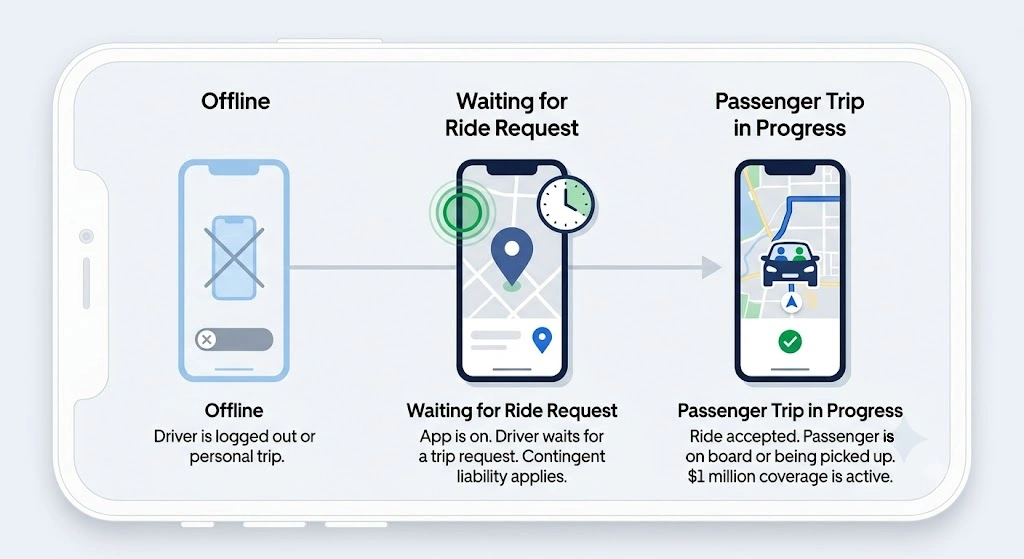
App on and waiting for a ride request
Contingent liability of $50,000 per person and $100,000 per accident and $25,000 property damage
Same contingent limits
The personal policy of the driver first and the rideshare company insurance fills the gap
Period 2
Ride accepted and driving to the pickup
Up to $1 million third party liability
Up to $1 million
The commercial insurance policy of the rideshare company
Period 3
Passenger on board and ride in progress
Up to $1 million third party liability plus uninsured and underinsured motorist coverage
Up to $1 million plus UM and UIM
The commercial insurance policy of the rideshare company
Period 1 is the rideshare insurance gap coverage problem. Look at the jump. A driver with the app on and nobody in the back seat carries $50,000 per person. Fifteen minutes later that same driver picks up a fare and the number becomes $1,000,000. One surgery and a week in the hospital can pass $50,000 before you leave the building. That gap is why the app record matters so much and why insurance companies fight over it.
Uber provides these limits under its published Texas policy and Lyft mirrors them closely. Both companies of the Uber and Lyft type update their coverage terms periodically, so the numbers on any given claim should be pulled fresh from the certificate of insurance rather than from memory.
If your ride was with Lyft rather than Uber, the structure is the same and the paperwork differs. Our Lyft accident attorney page covers what the Lyft accident claim process looks like from the first notice through settlement.
What Counts as a Rideshare Accident
Definition: A rideshare accident is any motor vehicle accident involving a driver who was logged into a transportation network company app such as Uber or Lyft at the time of the accident, whether or not a passenger was in the car.
That definition matters because four different kinds of people get hurt in these crashes and each one follows a different path:
The rideshare passenger. You were riding in an Uber or a Lyft as a paying customer. You are almost never at fault and you have the cleanest claim of anyone involved.
The rideshare driver. You were behind the wheel with the app on. Your options depend on your app status, your personal auto insurance and whether another motorist is responsible.
The occupant of the other vehicle. You were hit by an Uber or Lyft driver in your own car.
A pedestrian or a cyclist. Struck by a rideshare vehicle on a Weslaco street or crossing lot.
An Uber passenger and a Lyft passenger have essentially identical rights. The claim number and the adjuster change. The law does not.
How Do Rideshare Accident Claims Work in Weslaco, Texas? 6
The Rideshare Accident Claim Process Step by Step
Follow this order. Skipping a step here is what costs people money later.
Get medical care the same day. Go to the emergency room or an urgent care clinic even if you think you can walk it off. Adrenaline hides soft tissue injuries for a day or two and a gap in treatment is the first thing an insurance adjuster will use against you.
Report the accident inside the Uber or Lyft app. Both apps have a crash reporting flow. Reporting through the app timestamps the trip and creates a record that the rideshare driver was logged in and on an active ride.
Call the police from the accident scene. Ask for a Texas Peace Officer Crash Report, known as the CR-3. In Weslaco that means Weslaco PD or DPS depending on where the accident occurred. You can request a copy through TxDOT later.
Screenshot everything in your app. Capture the trip receipt, the route map, the driver name and photo and the timestamp. Your ride history does not stay visible forever and this is the proof of which coverage period applies.
Photograph the vehicles and the road. Position of the cars. Skid marks. Debris. Traffic signals. Visible injuries on you. Do this before anyone moves a vehicle if it is safe to stay put.
Collect insurance information from every driver. The rideshare driver and any other motorist involved. You want policy numbers, not just names.
Notify the insurance companies but decline the recorded statement. Report the claim. Then stop. Do not give a recorded statement to any adjuster until you have spoken with an attorney.
Track every dollar. Medical bills, prescriptions, physical therapy, missed shifts, lost wages, mileage to appointments. Keep a folder.
Talk to a rideshare accident lawyer before you sign anything. A settlement release is permanent. Once you sign it you cannot reopen the claim if your injury turns out to be worse than anyone thought.
Documenting the accident is critical and the first forty eight hours after a rideshare accident are critical in a way that a typical car accident is not, because the strongest evidence lives on a server that belongs to somebody else.
When the Other Driver Caused the Accident or Has No Insurance
Say the Uber you were riding in got broadsided by a pickup that ran a stop sign. The rideshare driver did nothing wrong. Your claim goes first against the liability policy of the pickup driver.
Then you check the limits and find he carried Texas minimum coverage of $30,000 per person. Your hospital bill alone is $90,000.
This is where Period 2 and Period 3 coverage saves the claim. Uber and Lyft both carry uninsured and underinsured motorist coverage during those periods, and it can reach up to $1 million. If you were injured as an Uber passenger and the at fault motorist cannot cover your damages, that UM and UIM coverage steps in behind him. Most rideshare accident victims have no idea it exists and no adjuster volunteers it.
If you were the Uber or Lyft driver rather than a passenger, your path runs differently. You may have personal injury protection on your own policy. You may have UM and UIM on your own policy. Uber and Lyft both offer contingent comprehensive and collision coverage for vehicle damage during Periods 2 and 3 and both carry a deductible you pay first.
How Long a Claim Takes and What It Is Worth
Nobody can quote you a number in the first phone call and anybody who does is guessing. What we can give you is a realistic range on timing.
Straightforward injury with clear liability: three to six months from treatment completion to settlement
Disputed liability or serious injury requiring surgery: nine to eighteen months
Cases that go into litigation: eighteen to thirty months
The damages available in a personal injury claim of this type include medical expenses already incurred, the cost of future medical care, lost wages, reduced earning capacity, pain and suffering and property damage. A rideshare accident claim in Texas follows the Texas Civil Practice and Remedies Code. An accident claim in California runs under a different fault system entirely, which is why so much of the advice you find online does not apply to you here.
Prior results do not guarantee or predict a similar outcome in any future case.
Why These Claims Are Harder Than a Standard Car Accident Claim
A rideshare accident can be complicated in ways a traditional car accident never is. Here is what makes the difference:
Multiple insurance policies argue with each other over which one is primary, and while they argue your bills keep arriving
App status disputes turn on data that only the rideshare company holds, and that data gets overwritten on a schedule
Independent contractor classification blocks direct corporate liability and pushes everything onto the insurance layer
Commercial adjusters who handle nothing but claims involving rideshare vehicles are far more experienced at this than a first time claimant
Arbitration clauses sit inside the terms of service you accepted when you installed the app
Evidence preservation letters have to go out early or the trip data is simply gone
Where Rideshare Accidents Happen Around Weslaco
Weslaco sits in the middle of the Mid Valley with Expressway 83 and IH-2 running straight through it. Add the traffic feeding in from Mercedes, Donna and Alamo and you get steady rideshare volume on a road system that was not built for it.
The intersections that generate the most calls to our office involve Texas Boulevard, Westgate Drive, Business 83 and the frontage roads along IH-2 where drivers merge across two lanes to catch an exit. Hidalgo County carries some of the heaviest crash volume in South Texas and rideshare demand climbs on weekends, on holidays and around events in the Valley.
If your injury came out of a collision anywhere in the Mid Valley, our personal injury lawyer in Weslaco TX page explains how we handle cases close to home.
Texas Rules That Decide Your Claim
The Texas law that applies to your rideshare accident case
Two year filing deadline. Under Texas Civil Practice and Remedies Code Section 16.003 you generally have two years from the date of the accident to file suit. Miss that date and the claim is gone no matter how strong your evidence is. Our post on the Texas personal injury statute of limitations covers the narrow exceptions.
Modified comparative fault and the 51 percent bar. Texas Civil Practice and Remedies Code Section 33.001 lets you recover only if you are 50 percent or less responsible. At 51 percent you recover nothing. Below that line your award drops by your percentage of fault.
Wrongful death standing. Texas Civil Practice and Remedies Code Section 71.004 gives a surviving spouse, children and parents the right to bring a wrongful death action. A Texas wrongful death lawyer can explain how the two year clock runs from the date of death.
TNC insurance mandate. Texas Insurance Code Chapter 1954 requires companies like Uber and Lyft to carry the tiered coverage described above.
No damage cap. Ordinary motor vehicle negligence cases in Texas carry no cap on economic or non economic damages. Caps apply to medical malpractice and certain claims against government entities and not to your rideshare accident claim.
Texas Crash Data Worth Knowing
Statistic
Year
Source
Why it matters to you
At least one person has died on a Texas roadway every single day since November 7, 2000
Ongoing since 2000
TxDOT
Texas roads carry sustained risk and rideshare vehicles share every mile of it
4,283 people died in Texas traffic crashes
2023
TxDOT
Establishes the scale of serious motor vehicle accident exposure statewide
40,901 people died in traffic crashes nationwide
2023
NHTSA
National context for the road risk your claim sits inside
36 percent of American adults reported having used a ride hailing service
2018
Pew Research Center
Shows how ordinary these trips have become and why these claims keep rising
$1,000,000 third party liability limit during Periods 2 and 3
Current
Uber and Lyft published insurance terms
The single number most rideshare accident victims came looking for
Mistakes That Cost People Money
Giving a recorded statement before you have counsel. Adjusters use small inconsistencies to argue your injury predated the accident.
Skipping the emergency room because you felt fine. Delayed treatment is the number one argument used to discount injury value.
Failing to screenshot the trip receipt. App records establish which insurance policy applies and your rider history does not stay available forever.
Accepting the first offer. Early offers arrive before the full medical picture exists and the release you sign is final.
Assuming Uber or Lyft automatically covers everything. Period 1 coverage is a fraction of Period 3 and the wrong app status can cut available coverage by ninety five percent.
Posting about the accident on social media. One photo at a birthday party is enough to fuel a defense that you were never really hurt.
Waiting past the two year deadline. Section 16.003 extinguishes the claim regardless of merit.
Never identifying the insurance carrier of the at fault motorist. The primary policy may belong to him and not to the rideshare company.
What We See in These Cases
“In our experience handling rideshare accident cases across Texas, the outcome often turns on one fact nobody at the accident scene thinks to capture. Whether the driver had already accepted the ride. Personal injury cases in Texas are handled on a contingency fee. The attorney’s fee is a share of what we recover, agreed in writing before the case begins. You pay no attorney’s fee and no case expenses unless we recover for you. The exact percentage is set out in the written agreement you sign.
Fernando J. Lopez, The Lopez Law Group
When to Call a Lawyer
Not every fender bender needs an accident attorney. A scraped bumper and a sore shoulder that clears up in a week is something you can handle yourself. These situations are different.
Call an experienced rideshare accident attorney if:
Anyone was hospitalized or needed surgery or has an injury expected to last more than a few weeks
The insurance companies are arguing about which coverage period applied
More than one vehicle or more than one insurance carrier is involved
An adjuster has already asked for a recorded statement or floated a quick settlement number
The motorist who caused the accident was uninsured or carried minimum limits
The accident was fatal
An experienced Uber accident attorney can help you pin down app status before the data ages out, and an Uber accident lawyer who has handled these files knows which carrier to put on notice first. That early experience with Uber and Lyft claim handling is where most of the value gets created.
The Lopez Law Group takes rideshare accident cases on a contingency fee basis. No win, no fee. You owe nothing unless we recover for you. Consultations are free. Call (956) 968-7800 to discuss your rideshare accident with our office.
Frequently Asked Questions
How do rideshare accident claims work if I was a passenger?
As a rideshare passenger you file against whichever insurance policy applies based on the app status of your driver at the time of the accident. If the driver was transporting a passenger, the $1 million commercial policy of the rideshare company responds. If another motorist caused the accident, his liability insurance pays first.
You are almost never assigned fault as a passenger, which makes your claim the cleanest one arising from the accident.
Who is liable in an Uber accident, the driver or Uber?
Liability rests with whichever driver caused the accident, not automatically with Uber. Because Uber classifies drivers as independent contractors, you usually cannot hold the corporation directly responsible for driver negligence. What you can reach is the commercial insurance policy Uber carries, which responds when the driver was on an accepted trip.
Does Uber insurance cover accidents when the app is off?
No. When the app is off the driver is on a personal trip and only the personal insurance of that driver applies. Uber coverage begins the moment the driver logs in and increases in stages as the driver accepts a request and then picks up a rider. App status at the time of the accident controls everything.
What is the Lyft accident claim process?
The Lyft accident claim process starts with reporting the accident through the Lyft app, which timestamps the trip and preserves the record. Lyft assigns a claim number and routes it to its commercial carrier. You then submit medical records and bills and wage documentation, and the adjuster evaluates the file before making an offer.
Expect the same three period coverage structure Uber uses.
What is rideshare insurance gap coverage?
Rideshare insurance gap coverage refers to Period 1, when the driver has the app on and has not accepted a ride. Personal auto insurance often excludes commercial activity and the rideshare contingent policy carries much lower limits of $50,000 per person. That mismatch between exclusion and low limits is the gap that leaves accident victims short.
Can I sue Uber or Lyft directly after an accident?
Direct suits against Uber and Lyft face the independent contractor defense and arbitration clauses inside the app terms of service. Most valid claims proceed against the insurance policies rather than the corporation. Direct corporate liability becomes possible in narrower situations such as negligent retention of a driver with a documented dangerous history.
How long do I have to file a rideshare accident claim in Texas?
Texas Civil Practice and Remedies Code Section 16.003 gives you two years from the date of the accident to file a personal injury lawsuit. Wrongful death claims run two years from the date of death. A handful of exceptions exist for minors and for claims against government entities, and they are narrow.
Waiting is the single most common way people lose an otherwise strong claim.
What if the rideshare driver was not at fault?
Then your claim runs against the liability insurance of whoever caused the accident. If that motorist is uninsured or carries limits too low to cover your damages, the uninsured and underinsured motorist coverage carried by Uber and Lyft during Periods 2 and 3 may cover the shortfall up to the policy limits.
Very few accident victims know this coverage exists.
Do I need a rideshare accident lawyer or can I handle the claim myself?
You can handle a minor property damage claim yourself. Once real injuries are involved, a rideshare accident lawyer can help by identifying every applicable insurance policy, preserving app data before it ages out and keeping you from statements that reduce your recovery. Experienced rideshare accident attorneys also know what similar files have settled for.
What if I was the rideshare driver and I got hurt?
As an Uber or Lyft driver you may recover through the liability policy of the motorist who caused the accident, through your own personal injury protection, through your own UM and UIM coverage or through the contingent coverage the rideshare company provides during Periods 2 and 3. Contingent comprehensive and collision carries a deductible you pay first.
Will filing a claim affect my Uber or Lyft account?
Filing an injury claim as a passenger does not put your rider account at risk. Rideshare companies process passenger injury claims through their insurance carriers as a routine matter. Drivers filing claims may see temporary account deactivation while the company reviews the incident, which is standard procedure and not a penalty.
How much does a rideshare accident lawyer cost?
Our law firm handles rideshare accident cases on a contingency fee. You pay no upfront cost and no hourly rate. The fee comes as a percentage of what we recover for you, and if we recover nothing you owe nothing. This structure lets injury victims hire counsel without money changing hands at the start.
Talk to Someone Who Handles These Cases
The whole thing comes down to three facts. App status decides which insurance policy applies. Fault decides who pays. Texas gives you two years and not a day more. Knowing how rideshare accident claims work is what keeps an adjuster from settling your file for a fraction of what it is worth.
Call The Lopez Law Group at (956) 968-7800 for a free case review. No win, no fee. Hablamos español. follow us on Facebook, Instagram, and Xfor the latest updates!
About the Author
Fernando J. Lopez is a Texas personal injury attorney with 18 years of experience representing injured people and their families. Attorney Lopez serves clients in English and Spanish from offices in Weslaco and Houston.
This post provides general information about Texas law and does not create an attorney client relationship. Prior results do not guarantee a similar outcome.