
By Attorney Fernando J. Lopez, Texas Personal Injury Lawyer | Updated June 12, 2026
who is at fault in a bicycle accident? You were riding your bike. A car hit you. Now you’re dealing with injuries, medical bills, and a driver who may already be telling a different story. One question probably keeps coming up: who is actually at fault here?
Fault in a bicycle accident is not decided by who has four wheels and who has two. Texas law looks at negligence — who acted carelessly and caused the crash. In many cases, the driver bears full responsibility. But Texas also has shared-fault rules that can affect your compensation. The Lopez Law Group has helped injured cyclists across Texas get answers and recover damages after these crashes. This guide walks you through exactly how fault works, what the law says, and when you need an attorney on your sid
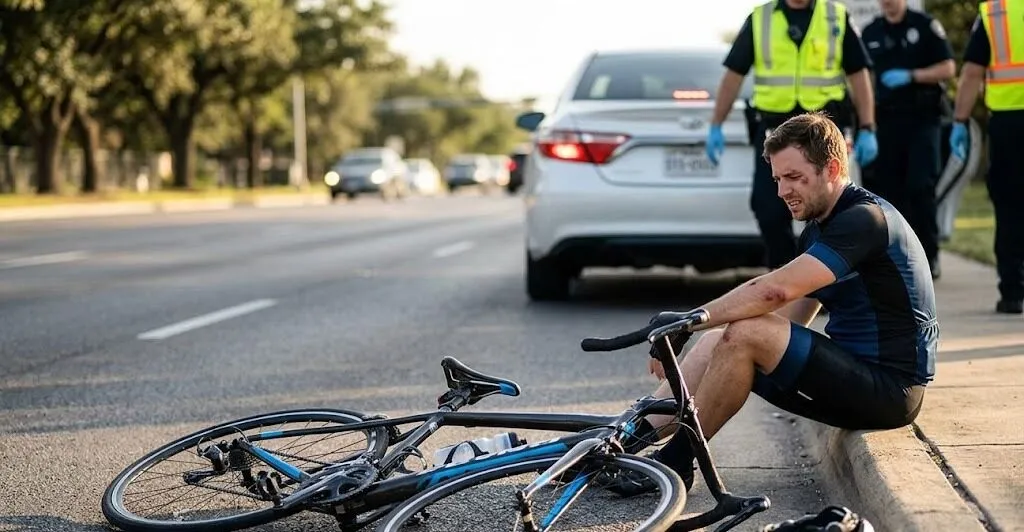
Quick Answer In a bicycle accident in Texas, fault goes to the party whose negligence caused the crash. Drivers are often liable when they fail to yield, speed, or drive distracted. Cyclists can share fault if they broke traffic laws. Under Texas’s modified comparative negligence rule, you can still recover compensation as long as you are 50% or less at fault — but your award is reduced by your percentage of responsibility. A bicycle accident attorney can gather evidence to fight for the strongest possible outcome.
Table of Contents
How Texas Law Determines Fault in a Bicycle Accident
Texas uses a negligence-based fault system. To hold someone legally responsible for a bicycle accident, you need to show four things:
- Duty — The other party owed you a duty of care. Drivers owe every cyclist on the road a duty to drive safely.
- Breach — They broke that duty. Speeding, running a red light, texting — these are all breaches.
- Causation — Their breach caused the crash and your injuries.
- Damages — You suffered real harm: physical injuries, medical costs, lost wages, pain.
When all four elements are present, the negligent party is liable. The challenge is proving it — especially when an insurance adjuster is already working to minimize the driver’s share of blame.
Key Term: Negligence Negligence means a person failed to act with the care a reasonable person would use under the same circumstances. On the road, that means following traffic laws, watching for cyclists, and not driving distracted.
Bicycle accident liability in Texas covers more than just the driver of the car. Depending on the facts, liability can extend to:
- The driver’s employer (if they were working at the time)
- A government entity (if a dangerous road defect contributed to the crash)
- A vehicle manufacturer (if a defect caused the driver to lose control)
Common Situations Where the Driver Is at Fault
Drivers cause the majority of serious bike crashes. Here are the most common scenarios where the driver bears primary or full responsibility:
- Failure to yield at intersections. A driver turns right or left without checking for cyclists in the bike lane or crosswalk.
- Dooring. A parked driver opens their door into the path of an oncoming cyclist. Texas courts have found drivers liable for this.
- Distracted driving. A driver texting or adjusting a phone misses a cyclist entirely.
- Speeding. A driver traveling too fast to stop when a cyclist enters their path.
- Driving under the influence. An impaired driver drifts into the shoulder or bike lane.
- Failure to maintain safe distance. A driver passes a cyclist with less than the legally required clearance.
- Running a stop sign or red light. A driver blows through a controlled intersection and strikes a cyclist legally crossing.
In each of these situations, the driver violated a duty of care. The cyclist is the victim. That should — and often does — translate to a finding of full liability against the driver in a Texas bike accident claim.
When a Cyclist May Share Fault
Texas law treats cyclists as vehicle operators. That means cyclists must follow the same traffic laws as drivers. When a cyclist breaks those rules and the violation contributes to the crash, the cyclist may be assigned a share of fault.
Common cyclist actions that can affect bike accident fault determination:
- Riding against traffic
- Ignoring stop signs or red lights
- No lights or reflectors after dark
- Riding under the influence of alcohol or drugs
- Abruptly cutting into traffic without signaling
- Riding in the wrong lane or on an expressway where prohibited
Shared fault does not automatically mean you lose your claim. It depends on how much fault is assigned to each side — which brings us to the rule that controls every Texas bicycle accident settlement involving mixed blame.
Texas’s Modified Comparative Negligence Rule Explained
Texas Legal Notice Texas Civil Practice and Remedies Code — Modified Comparative Negligence
- Under Chapter 33 of the Texas Civil Practice and Remedies Code, Texas follows the 51% modified comparative negligence rule.
- If you are found 50% or less at fault, you can recover damages — but your award is reduced by your percentage of fault.
- If you are found 51% or more at fault, you are barred from recovering any compensation at all.
- Statute of limitations: Under §16.003, you have two years from the date of the bicycle accident to file a personal injury lawsuit in Texas.
- These rules apply to all bicycle accident claims filed in Texas courts, including those in Hidalgo County, Cameron County, Harris County, and Dallas County.
Here is what this means in practice. Say a jury finds you 20% at fault for riding without lights after dark, and the driver 80% at fault for speeding. Your total damages are $100,000. You recover $80,000 — the $100,000 reduced by your 20% share of fault.
Now flip it: if the jury assigns you 55% fault, you walk away with nothing. That is why how fault is argued — and what evidence you present — matters enormously. Insurance adjusters know this rule. They will push to inflate your percentage of fault to reduce or eliminate your payout. An experienced bike injury lawyer in Texas protects you from that strategy.
How Bicycle Accident Liability Is Proven
Proving who is at fault in a bicycle accident requires real evidence. Here is how a Texas bicycle accident attorney builds a liability case:
- Obtain the police report. The responding officer often records observations about who violated traffic law. This is a starting point, not the final word.
- Gather witness statements. Bystanders, pedestrians, and nearby business employees often saw what happened. Their accounts matter — especially when they contradict the driver’s version.
- Request traffic camera or dashcam footage. Many Texas intersections have cameras. Nearby businesses may have exterior footage. This must be requested quickly — footage gets overwritten.
- Preserve physical evidence. Your bike, your helmet, your clothing — all of it can show the direction and force of impact.
- Hire an accident reconstruction expert. In contested liability cases, a reconstruction expert can use skid marks, road geometry, and vehicle damage to establish how the crash happened.
- Pull cell phone records. If distracted driving is suspected, phone records can show the driver was texting at the moment of impact.
- Document your injuries. Medical records linking your injuries to the crash support both causation and damages.
- Analyze the road conditions. Potholes, missing signage, and dangerous bike lane design can point to third-party liability.
Each step has a deadline. Evidence disappears. Witnesses move on. The sooner you get legal help, the stronger your bicycle accident claim in Texas will be.
What Compensation You May Recover After a Bike Crash
| Damage Type | What It Covers |
| Medical expenses | ER visits, surgeries, physical therapy, future care |
| Lost wages | Income missed while recovering |
| Reduced earning capacity | Long-term income loss from permanent injury |
| Pain and suffering | Physical pain and emotional distress |
| Property damage | Bike repair or replacement |
| Loss of enjoyment of life | Activities you can no longer do |
Texas law does not cap most personal injury damages in bicycle accident cases. What you may recover depends on the severity of your injuries, the strength of the evidence, and how well your attorney negotiates or litigates.
The English disclaimer applies here: past results do not guarantee future outcomes. Every case is different, and no attorney can promise a specific result.
Texas Laws Cyclists and Drivers Must Know
For drivers:
- Texas Transportation Code §551.103 requires drivers to pass cyclists with at least three feet of clearance.
- §545.060 prohibits unsafe lane changes that endanger cyclists.
- §545.151 requires drivers to yield to cyclists lawfully in an intersection.
For cyclists:
- Texas Transportation Code §551.101 gives cyclists all the rights and duties of vehicle operators.
- Cyclists must ride in the same direction as traffic.
- §551.104 requires a front white light and rear red reflector when riding after dark.
- Cyclists may ride on any road except where expressly prohibited (e.g., certain limited-access highways).
Knowing these laws matters because both sides will argue them. If you followed every rule and the driver did not, that is powerful evidence in your favor. If you broke a rule, the defense will highlight it. Your attorney’s job is to put each fact in its proper legal context.
Statistics: Bicycle Accidents in Texas
| Statistic | Year | Source | Why It Matters |
| 2,193 cyclists injured in Texas traffic crashes | 2023 | Texas Department of Transportation (TxDOT) | Shows scope of the problem in Texas |
| 88 cyclists killed in Texas crashes | 2023 | TxDOT Crash Statistics | Highlights fatal risk; most involve motor vehicles |
| Cyclist fatality rate highest in urban counties | 2023 | TxDOT | Harris, Dallas, Bexar counties top the list |
| 37% of fatal bike crashes involved a driver failure to yield | 2022 | NHTSA Traffic Safety Facts | Failure to yield = leading cause of cyclist death |
| Cyclists are 7x more likely to die in a crash than car occupants per trip mile | 2024 | National Highway Traffic Safety Administration (NHTSA) | Explains why injury severity in bike crashes is high |
According to TxDOT’s 2023 crash data, hundreds of serious bicycle accidents happen every year on Texas roads — including along corridors like US-83, IH-2, IH-69, and US-281 in the Rio Grande Valley. Cyclists in McAllen, Houston, and Dallas face risk every day. The numbers behind these crashes are not abstract. Each one represents a real person with real injuries and real bills.
Mistakes That Can Cost You Your Claim
- Apologizing at the scene. Even “I’m sorry” can be twisted into an admission of fault by an insurance adjuster.
- Skipping medical care. If you do not see a doctor right away, the insurer will argue your injuries are not serious — or were not caused by the crash.
- Posting on social media. Photos or comments about your accident, your activities, or your recovery can be used against you in negotiations or court.
- Giving a recorded statement to the driver’s insurer. You are not required to do this, and it rarely helps your case. Adjusters are trained to ask questions that shift blame.
- Accepting a fast settlement. Early offers often come before the full extent of your injuries is known. Accepting one may waive your right to future compensation.
- Waiting too long to call a lawyer. Critical evidence — traffic camera footage, witness memories, electronic data — has a short shelf life.
- Failing to document everything. Photos of the scene, your injuries, your damaged bike, and the road conditions are evidence. Take them while you can.
- Assuming you cannot recover because you share some fault. Texas law allows recovery when you are 50% or less at fault. Do not walk away without speaking to an attorney first.
Attorney Lopez’s Perspective
“In our experience handling bicycle accident cases across Texas — from the Rio Grande Valley to Houston and Dallas — insurance companies almost always try to pin some fault on the cyclist, even when the driver clearly caused the crash. We document the scene early, pull every available piece of evidence, and push back hard on unfair fault assignments. You were on that road legally. Your rights matter.” — Attorney Fernando J. Lopez, The Lopez Law Group
When to Call a Bicycle Accident Attorney
Some situations call for professional legal help from the start. If any of the following apply, contact a bike injury lawyer in Texas before speaking further with any insurance company:
- You suffered serious injuries — broken bones, head trauma, spinal injuries, or anything requiring surgery
- The driver disputes fault or claims you caused the crash
- The driver was uninsured or underinsured
- A government vehicle or road defect may be involved
- The driver was working at the time of the crash (employer liability may apply)
- The insurance company is offering a quick settlement before you know your full prognosis
- You are being contacted repeatedly by adjusters or opposing attorneys
- The crash happened in a complex location — a highway on-ramp, a mixed-use intersection, a construction zone
At The Lopez Law Group, we serve clients in English and Spanish. Call us at (956) 968-7800 for a free case evaluation. We work on contingency — no fee unless we win.
Frequently Asked Questions
Who is at fault if a car hits a cyclist from behind?
In rear-end bicycle accidents, the driver of the car is almost always at fault. Drivers have a duty to maintain a safe following distance and pay attention to what is ahead. A rear-end collision typically signals the driver was not watching the road, was following too closely, or was speeding. Texas law strongly supports cyclist rights in these situations.
Can a cyclist be found more than 50% at fault in Texas?
Yes. Under Texas’s modified comparative negligence rule, a court can assign more than 50% fault to a cyclist — but if that happens, the cyclist cannot recover any compensation. This is why building strong evidence of the driver’s negligence from the start is so important.
What if the driver claims I swerved into traffic?
You have the right to dispute that claim with evidence. A police report, witness statements, traffic camera footage, and an accident reconstruction expert can all contradict a driver’s version of events. Do not assume the driver’s account will go unchallenged — that is exactly what an attorney is for.
Does Texas require cyclists to wear helmets?
Texas state law does not require adult cyclists to wear helmets. Some cities have their own ordinances. Not wearing a helmet may be raised by the defense to argue you contributed to your own injuries — but it does not bar your recovery entirely if the driver caused the crash.
Who pays in a bicycle accident when the driver has no insurance?
If the driver is uninsured, you may have options through your own auto insurance policy’s uninsured motorist (UM) coverage, even if you were on a bike at the time. You may also have a claim against the driver personally. An attorney can help identify every available source of recovery.
How long does a Texas bicycle accident claim take?
Most Texas personal injury claims — including bicycle accident cases — resolve in six to twelve months. Complex cases involving severe injuries, disputed liability, or litigation can take longer. Accepting an early settlement can shorten the timeline but often shortchanges the final amount.
Can I sue the city if a road defect caused my bike accident?
Yes, but claims against government entities in Texas follow special rules. Under the Texas Tort Claims Act, you typically have six months to file a formal notice of claim — much shorter than the standard two-year deadline. Missing that window can end your case before it starts.
What evidence should I collect at the scene of a bike crash?
Photograph everything: the vehicle, your bike, the road, your injuries, skid marks, and any signage. Get the driver’s name, license plate, insurance information, and contact details. Get the names and phone numbers of any witnesses. Call 911 so a police report is filed. Do not move your bike if you can avoid it before photos are taken.
Do cyclists have the same rights as drivers in Texas?
Yes. Under Texas Transportation Code §551.101, cyclists have the same rights and duties as motor vehicle operators. That means drivers must share the road with cyclists and follow the same rules of the road that apply to all vehicles.
What if I was hit by a car while riding in a bike lane?
If a driver entered or crossed a bike lane and struck you, that driver likely violated Texas Transportation Code §545.060. Being in a designated bike lane strengthens your argument that you were operating lawfully. Document the lane markings if they are still visible after the crash.
Is bicycle accident negligence different from car accident negligence in Texas?
The legal framework is the same — duty, breach, causation, damages. What differs is the facts at issue. Bike crashes often involve questions about lane position, visibility, and right-of-way that do not come up in typical car accidents. The same Texas civil liability rules apply, but the specific Traffic Code sections that govern cyclists are different.
Can I still recover damages if I was not wearing a helmet?
Possibly yes. Texas does not require adult helmets, and not wearing one does not bar your recovery. However, the defense may argue that a helmet would have reduced your head injuries, potentially affecting your damages. This is a legal argument an experienced bicycle accident attorney in Texas can address directly.
Get Help From The Lopez Law Group {#cta}
A bicycle crash can change your life. Medical bills pile up fast, recovery takes time, and the driver’s insurance company is not on your side. You deserve someone who is.
If you or someone you love was hit by a car on a bike in Texas — whether in McAllen, Houston, Dallas, Harlingen, Edinburg, or anywhere in between — The Lopez Law Group is ready to fight for you. We serve clients in English and Spanish. Our firm has helped Texas injury victims recover more than $25 million. We work on contingency: you pay nothing unless we win your case.
Call our Texas bicycle accident attorneys today at (956) 968-7800. Free consultation. Available 24/7. Follow us on Facebook, Instagram, and X for the latest updates!
About Attorney Fernando J. Lopez
Fernando J. Lopez is a Texas personal injury attorney with more than 15 years of experience representing injured clients across the state. He leads The Lopez Law Group, with offices in Weslaco, Houston, and Austin, serving clients throughout South Texas — including Hidalgo County and Cameron County — and beyond. His firm has recovered more than $25 million for accident victims. Attorney Lopez handles cases in both English and Spanish and is recognized by the National Trial Lawyers Top 100, the National Association of Distinguished Counsel, and Expertise.com as one of the Best Personal Injury Lawyers in McAllen. He is a member of the American Institute of Personal Injury Attorneys (AIOPIA).
Read Attorney Lopez’s full bio

