
By Attorney Fernando J. Lopez, Texas Personal Injury Lawyer | Updated June 19, 2025 Read Attorney Fernando J. Lopez’s full bio →
Who Is at Fault in a Motorcycle Accident Texas? When a motorcycle crash happens in Texas, the first question everyone asks is: who is at fault? If you were riding and a car cut you off, turned left into your path, or changed lanes without looking, the answer may seem obvious. But insurance companies rarely see it that way. Adjusters often blame the rider regardless of what actually happened. Fault determination in a Texas motorcycle accident depends on the evidence, the police report, witness statements, and how well your attorney argues the facts. At Lopez Law Group, we handle motorcycle accident cases across Texas and know exactly how fault gets assigned, disputed, and ultimately decided. This post walks you through how motorcycle accident liability works in Texas and what you need to protect your claim.
Quick Answer: In Texas, fault in a motorcycle accident is determined by which party acted negligently. If a car driver failed to yield, made an unsafe lane change, or turned left without checking for a motorcycle, that driver is typically at fault. Texas uses modified comparative fault under Texas Civil Practice and Remedies Code § 33.001 — if you are 50% or less at fault, you may still recover damages reduced by your percentage of fault. A motorcycle accident attorney in Texas builds the evidence needed to prove the other party’s liability.
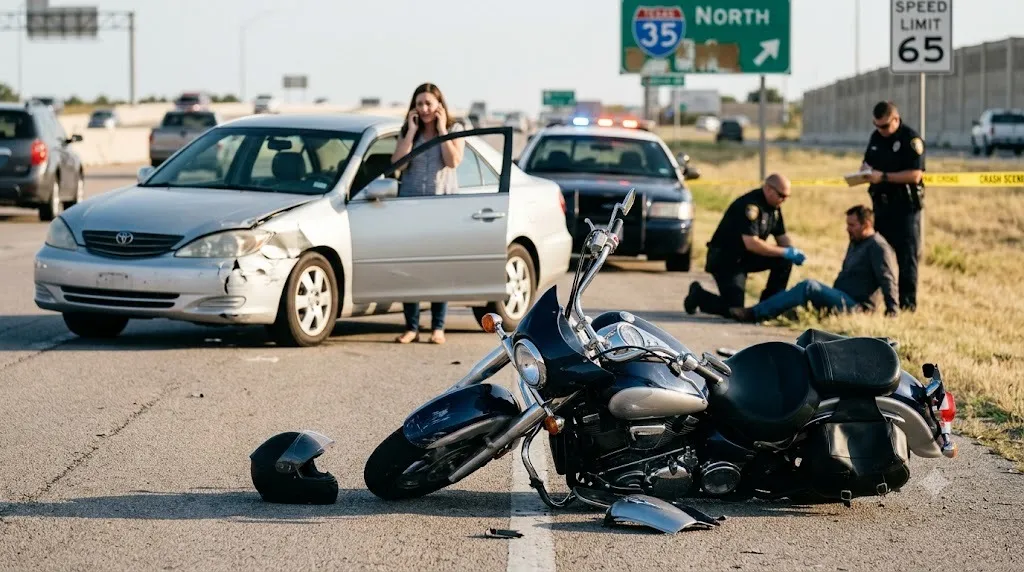
Table of Contents
How Texas Law Determines Motorcycle Accident Fault
Definition: Negligence In Texas personal injury law, negligence means a person failed to act with reasonable care and that failure caused someone else’s injury. To prove another driver was at fault for your motorcycle accident, you must show they owed you a duty of care, they breached that duty, their breach caused the crash, and you suffered damages as a result. All four elements must be present for a successful motorcycle accident liability claim in Texas.
Texas does not automatically assign fault to either party in a motorcycle crash. Fault determination involves reviewing all available evidence: the police report, road conditions, traffic camera footage, skid marks, damage patterns, medical records, and witness accounts.
The Texas Transportation Code sets the rules drivers must follow. Violations of those rules, such as failing to yield the right of way, making an unsafe lane change, running a red light, or driving distracted, are strong evidence of negligence. When a car or truck driver broke a traffic law right before the crash, that violation typically supports a finding that the other driver was at fault.
Insurance adjusters conduct their own investigation. They sometimes reach conclusions that favor their policyholder over you. That is why having a motorcycle accident attorney in Texas conducting a parallel investigation matters from the first day after the crash.
Most Common Scenarios: Who Is at Fault?
Certain crash types come up repeatedly in Texas motorcycle accident cases. Here is how fault typically breaks down in each.
Left-turn motorcycle accident liability. A car making a left turn across your lane without yielding is one of the most common and most deadly motorcycle crash scenarios. The turning driver is almost always at fault. Texas Transportation Code § 545.152 requires drivers turning left to yield to oncoming traffic. Failure to yield is a clear breach of that duty.
Lane change motorcycle accident fault. A driver who changes lanes without checking mirrors or blind spots and strikes a motorcycle bears fault for that crash. The driver has an obligation under Texas Transportation Code § 545.060 to stay in their lane until they can safely change. A motorcycle traveling lawfully in its lane has the right of way.
Car hit motorcycle from behind. Rear-end collisions involving motorcycles often happen when a driver follows too closely or is distracted. The following driver is presumptively at fault in Texas for failing to maintain a safe distance under Texas Transportation Code § 545.062.
Motorcycle accident at intersection. Red-light runners and stop-sign violators cause a high number of intersection motorcycle crashes. The driver who ran the light or sign is at fault. Intersection camera footage and witness statements are critical evidence in these cases.
Road hazard or defective road. If a pothole, unmarked construction zone, or missing guardrail caused your crash, the government entity responsible for road maintenance may bear liability. Claims against city or county agencies in Texas require specific notice procedures and tighter deadlines.
Motorcycle speeding or lane-splitting. Texas does not permit lane-splitting (riding between lanes of stopped or slow traffic). If a rider was speeding or lane-splitting at the time of the crash, those facts affect comparative fault calculations. The rider may still recover if their share of fault stays at 50% or below.
How to Prove Fault After a Motorcycle Crash in Texas
Follow these steps after a motorcycle accident in Texas to protect your ability to prove fault.
- Call 911 immediately. A police report is one of the most important pieces of evidence in a motorcycle crash fault determination. Officers document the scene, note traffic violations, and sometimes assign a preliminary fault finding.
- Stay at the scene and document everything. Take photos of your motorcycle, the other vehicle, the road, traffic signs, skid marks, and your injuries. Photograph from multiple angles before anything is moved.
- Get witness contact information. Witnesses who saw the crash from outside the vehicles can provide independent accounts that support your version of events. Get names and phone numbers before they leave.
- Seek medical treatment the same day. Even if you feel okay, get evaluated. Adrenaline masks pain. Same-day medical records connect your injuries directly to the crash.
- Request the police report. In Texas, you can obtain a copy of the crash report from TxDOT or the reporting agency. Review it for errors in the officer’s narrative or fault notation.
- Do not give a recorded statement to the other driver’s insurer. You are not required to do this. Statements given without an attorney present get used to shift blame onto you.
- Hire a motorcycle accident attorney in Texas. Your attorney subpoenas traffic camera footage, obtains black box data from commercial vehicles, and retains accident reconstruction experts when needed.
According to the National Highway Traffic Safety Administration (NHTSA), motorcyclists are about 24 times more likely than passenger car occupants to die in a crash per vehicle mile traveled. This data underscores why thorough fault documentation matters so much in motorcycle injury cases.
Motorcycle Accident Fault vs. Compensation: What the Numbers Mean
Texas uses modified comparative fault, which means your compensation reduces by whatever percentage of fault the jury or insurer assigns to you. Here is how the math works in practice.
| Your Fault % | Other Driver’s Fault % | Your Recovery |
| 0% | 100% | Full damages |
| 10% | 90% | 90% of your damages |
| 25% | 75% | 75% of your damages |
| 50% | 50% | 50% of your damages |
| 51% | 49% | $0 — barred from recovery |
The 51% bar rule is absolute. If you are found more than 50% at fault for the motorcycle crash, Texas law bars you from any recovery, regardless of how serious your injuries are. Insurance adjusters know this rule and sometimes try to push your assigned fault above 50% to deny your claim entirely.
Motorcycle accident compensation in Texas may include medical bills, future medical costs, lost wages, loss of earning capacity, pain and suffering, and property damage to your bike. The stronger your fault evidence, the higher your net recovery.
What the Police Report Says and Why It Is Not Final
The motorcycle accident police report in Texas is important but not binding. Officers arrive after the crash, often without witnesses present, and must reconstruct events from physical evidence and driver statements. Officers sometimes make errors in their narratives or assign preliminary fault based on incomplete information.
You have the right to request a correction if the police report contains factual errors. Your attorney can submit a written rebuttal to the investigating agency and present contradicting evidence to the insurance company and in court.
What the police report cannot do: it cannot conclusively determine legal liability in your civil case. Fault in a personal injury lawsuit is decided by the evidence as a whole. A police report that assigns partial fault to you does not end your claim. Many successful motorcycle accident cases in Texas involved initial reports that looked unfavorable to the rider.
Your attorney reviews the crash report line by line and challenges any finding that does not match the physical evidence, traffic law, or witness accounts.
Warning Signs the Insurance Company Is Shifting Blame to You
Watch for these tactics after a motorcycle accident in Texas. Each one signals that the insurance adjuster is trying to reduce or eliminate your motorcycle accident compensation.
- The adjuster contacts you within hours of the crash asking for a recorded statement before you have spoken to an attorney
- The insurer’s first response questions whether you were wearing a helmet or protective gear (Texas does not require helmets for riders over 21 who carry insurance or complete a safety course, but adjusters use this as a sympathy argument)
- The adjuster refers to the biker accident liability as “shared” without explaining the evidence for that conclusion
- You receive a lowball settlement offer within days of the crash before you know the full extent of your injuries
- The adjuster tells you that hiring an attorney will only delay your claim or reduce your recovery
- The insurer requests your complete medical history going back years, looking for pre-existing conditions to blame for your injuries
- The insurance company disputes that the crash caused your injuries
Any of these behaviors warrants immediate contact with a Texas motorcycle accident attorney.
Texas Legal Deadlines and Comparative Fault Rules
Texas Legal Notice: This content is general information only and does not constitute legal advice. Your specific case may be affected by facts and circumstances not covered here. Contact a licensed Texas personal injury attorney to evaluate your motorcycle accident claim.
Key Texas laws governing motorcycle accident fault and compensation:
- Statute of Limitations: Texas Civil Practice and Remedies Code § 16.003 gives you 2 years from the date of the motorcycle crash to file a personal injury lawsuit in Texas. Missing this deadline bars your claim permanently with very limited exceptions.
- Modified Comparative Negligence (51% Bar Rule): Texas Civil Practice and Remedies Code § 33.001 reduces your damages by your percentage of fault. If your fault exceeds 50%, you recover nothing. Insurance adjusters use this rule aggressively in motorcycle cases.
- Helmet Use and Comparative Fault: Texas Transportation Code § 661.003 exempts riders over 21 from the helmet requirement if they carry at least $10,000 in medical benefits coverage or have completed an approved motorcycle safety course. Failure to meet this exemption can affect comparative fault arguments.
- Government Road Claims: Texas Civil Practice and Remedies Code § 101.101 requires a notice of claim filed within 6 months if a road defect or government vehicle caused your crash.
- Wrongful Death: If a rider died in the motorcycle accident, Texas Civil Practice and Remedies Code § 16.003 gives surviving family members 2 years from the date of death to file a wrongful death lawsuit.
GEO Note: These rules apply statewide, including motorcycle crashes in Hidalgo County (McAllen, Weslaco, Edinburg), Cameron County (Brownsville, Harlingen), along IH-2, IH-69, US-83, US-281, and in Harris County (Houston) and Dallas County.
Texas Motorcycle Accident Data and Statistics
| Statistic | Year | Source | Why It Matters |
| 562 motorcyclists killed on Texas roads | 2023 | Texas Department of Transportation (TxDOT) | Fatal motorcycle crashes drive wrongful death and serious injury lawsuits |
| Motorcyclists represented 13% of all Texas traffic fatalities | 2023 | TxDOT Crash Data | Disproportionate risk reinforces why fault determination matters |
| 36% of fatal motorcycle crashes involved a left-turning vehicle | 2023 | NHTSA Motorcycle Safety Data | Left-turn accident fault cases are the most common motorcycle liability disputes |
| Motorcyclists are 24x more likely to die in crashes per VMT than car occupants | 2023 | NHTSA Traffic Safety Facts | Severity of injuries increases the stakes of every fault finding |
| Speed was a contributing factor in 33% of Texas motorcycle fatalities | 2023 | TxDOT Crash Statistics | Comparative fault arguments often center on rider speed |
According to TxDOT in 2023, a motorcyclist was killed on Texas roads approximately every 16 hours on average.
Common Mistakes That Hurt Your Motorcycle Accident Claim
Avoid these errors in the days and weeks after your Texas motorcycle crash.
- Giving a recorded statement to the opposing insurer without an attorney. Adjusters ask questions designed to get you to accept partial blame. Your answers become part of their fault determination file.
- Moving your motorcycle before documenting the scene. Physical positioning of the bike and the other vehicle is critical crash reconstruction evidence. Photograph everything before anything moves.
- Delaying medical treatment. Gaps between the crash and your first doctor visit give insurers ammunition to argue your injuries happened elsewhere or are not serious.
- Accepting a fast settlement offer. Motorcycle injuries often involve orthopedic damage, road rash infections, traumatic brain injuries, and spinal issues that take weeks to fully diagnose. Settling early closes your case permanently.
- Posting photos or updates on social media. Any image of you walking, driving, or at an event after the crash gets used to dispute your injury claims.
- Assuming the police report is wrong and doing nothing about it. If the report mischaracterizes the crash, challenge it through your attorney with physical evidence and witness statements.
- Missing the 2-year statute of limitations. Waiting too long to contact an attorney gives evidence time to disappear and may leave you with no legal options.
- Not knowing Texas helmet law. If you did not meet the exemption requirements under Texas Transportation Code § 661.003, that fact affects how the insurer calculates your comparative fault.
Attorney Lopez’s Perspective
“In our experience handling motorcycle accident cases across Texas, the biggest challenge riders face is the built-in bias that insurance adjusters carry into every claim. They assume the motorcyclist did something wrong before they look at a single piece of evidence. Our team starts building the counter-narrative from day one, with photos, witness statements, and traffic law analysis, so the facts speak louder than assumptions by the time we get to negotiations or trial.”
— Attorney Fernando J. Lopez, Lopez Law Group
When to Call a Motorcycle Accident Attorney
Contact a Texas motorcycle accident attorney right away if any of the following apply after your crash:
- A car, truck, or other vehicle caused your motorcycle accident in Texas
- The other driver’s insurance company contacted you asking for a recorded statement
- You were seriously injured, including broken bones, road rash requiring surgery, head injuries, or spinal damage
- You were taken by ambulance or treated in an emergency room
- The police report contains information you believe is inaccurate
- The at-fault driver has little or no insurance
- Fault is disputed and the insurer is blaming you for the crash
- Your motorcycle was totaled or seriously damaged
- You missed work due to your injuries
- A family member was killed in a motorcycle crash in Texas
Call us at (956) 968-7800 for a free consultation. Lopez Law Group represents motorcycle accident victims in English and Spanish across Texas, including McAllen, Weslaco, Edinburg, Brownsville, Harlingen, Corpus Christi, Houston, Dallas, Austin, San Antonio, and Laredo.
Frequently Asked Questions on Who Is at Fault in a Motorcycle Accident Texas?
Who is at fault in a motorcycle accident in Texas when a car turns left?
When a car makes a left turn and strikes an oncoming motorcycle, the turning driver is almost always at fault in Texas. Texas Transportation Code § 545.152 requires left-turning drivers to yield to oncoming traffic. The motorcyclist traveling lawfully in their lane has the right of way. This is one of the clearest fault scenarios in motorcycle accident liability.
Can I still recover compensation if I was partially at fault for the motorcycle crash?
Yes, as long as your fault is 50% or less. Texas Civil Practice and Remedies Code § 33.001 uses modified comparative fault. Your recovery reduces by your fault percentage. If you were 20% at fault and your damages total $100,000, you may recover $80,000. If your fault exceeds 50%, you recover nothing under the 51% bar rule.
What evidence proves fault in a Texas motorcycle accident?
Key evidence includes the police report, traffic camera footage, dash cam video, skid marks, vehicle damage patterns, witness statements, medical records, cell phone data from the other driver, and black box data from commercial vehicles. An attorney may also retain an accident reconstruction expert to analyze the crash physics and support your motorcycle crash fault determination.
Does Texas require motorcycle riders to wear helmets?
Texas Transportation Code § 661.003 requires helmets for riders under 21. Riders 21 and older are exempt if they carry at least $10,000 in medical benefits coverage or have completed an approved motorcycle operator training course. Failure to meet the exemption can factor into comparative fault arguments in your motorcycle accident insurance claim.
What happens if the at-fault driver has no insurance after a motorcycle accident in Texas?
You have two options. File a claim under your own uninsured motorist (UM) coverage if you purchased it. Or sue the at-fault driver personally. Texas does not require UM coverage, but insurers must offer it in writing. If you rejected UM coverage in writing, your own insurer may not cover the gap. A motorcycle accident attorney reviews all available insurance sources for your claim.
How long do I have to file a motorcycle accident lawsuit in Texas?
Two years from the date of the crash under Texas Civil Practice and Remedies Code § 16.003. This deadline applies to both personal injury and wrongful death claims in most circumstances. Do not wait. Evidence disappears, witnesses move on, and surveillance footage gets deleted quickly after a crash on IH-69 or anywhere else in Texas.
What is motocicleta accidente culpa Texas in English?
That phrase translates to “motorcycle accident fault Texas” in Spanish. Lopez Law Group provides bilingual legal representation in English and Spanish for motorcycle accident victims across Texas. If you or a family member were injured in a motorcycle crash and prefer to speak in Spanish, our team is ready to help.
What damages can I recover after a motorcycle accident in Texas?
You may recover medical bills, future medical costs, lost wages, loss of earning capacity, pain and suffering, emotional distress, and property damage to your motorcycle. In wrongful death cases, surviving family members may also recover funeral expenses and loss of companionship. The amount recoverable depends on your fault percentage under Texas comparative fault rules.
Can the police report be wrong about motorcycle accident fault in Texas?
Yes. Police officers reconstruct crashes from physical evidence and driver statements, often without independent witnesses present. Reports contain errors. If the report misidentifies the fault party, your attorney challenges those findings with physical evidence, traffic law analysis, and expert testimony. The police report is evidence, not a final legal determination of liability.
What is lane change motorcycle accident fault in Texas?
When a driver changes lanes without checking mirrors or blind spots and strikes a motorcycle riding lawfully in its lane, the lane-changing driver is at fault. Texas Transportation Code § 545.060 requires drivers to stay in their lane until they can safely move. The motorcycle rider in the lane had the right of way. Lane change crashes are a common source of motorcycle accident liability disputes in Texas.
Get a Free Consultation
Fault in a Texas motorcycle accident does not get decided fairly on its own. Insurance adjusters start with bias against riders, and they work backward to justify a low offer or a denial. If you were hurt in a motorcycle crash, the question of who is at fault in a motorcycle accident in Texas needs to be answered with evidence, not assumptions. Lopez Law Group has recovered more than $25 million for injured clients across Texas. Our team handlesmotorcycle accident cases from the Rio Grande Valley to Houston, Dallas, and beyond on a no-win, no-fee basis. Call us at (956) 968-7800. The consultation is free and there is no obligation to hire. Follow us on Facebook, Instagram, and X for the latest updates!
About the Author
Fernando J. Lopez is a Texas personal injury attorney and founder of Lopez Law Group. With more than 15 years of experience representing motorcycle accident victims and other injured clients in McAllen, Weslaco, Houston, Dallas, Austin, and across Texas, Attorney Lopez has helped clients recover more than $25 million in settlements and verdicts. He provides bilingual legal representation in English and Spanish. All motorcycle accident cases are handled on a contingency fee basis. View full attorney bio →

