
By Fernando J. Lopez, Texas Personal Injury Attorney | Updated September 2, 2026
Reviewed by Fernando J. Lopez. State Bar of Texas #24060186. Licensed since November 2, 2007.
You are off the rig. The bills keep coming and nobody will give you a straight answer about what your case is worth. Here is the honest one. There is no fixed number for an oilfield accident settlement in Texas because four things set the value: how badly you were hurt and whether it is permanent, how much earning power you lost, whether your employer carries workers compensation or opted out of it and whether another company on that location shares the blame. At The Lopez Law Group we have watched two men with nearly identical injuries end up with completely different outcomes because of those factors. Below you will find what actually drives value, how workers comp compares to a lawsuit, who else can be held responsible, the deadlines that apply and the mistakes that quietly shrink payouts.
Quick Answer: There is no reliable average oilfield accident settlement in Texas. Value depends on injury severity, lost earning capacity, whether your employer is a workers compensation subscriber or a non-subscriber and whether a third party shares fault. Non-subscriber and third party claims generally allow full damages including pain and suffering. Workers compensation benefits do not. Texas gives most injury victims two years to file under Texas Civil Practice and Remedies Code Section 16.003.
What This Article Covers
What Sets the Value of an Oilfield Accident Settlement Texas
The value of a Texas oilfield accident claim comes from five things and the injury itself is only one of them. Two men can lose the same three fingers on the same rig floor in the same week and walk away with settlements that are nowhere near each other.
Here is what moves the number.
Severity and permanence. A crush injury that heals in eight weeks is a different case from an amputation, a spinal cord injury, a traumatic brain injury or a burn that requires years of grafts. Permanence is what turns a claim into a lifetime claim.
Lost earning capacity. This one matters more in oil and gas than almost any other industry because the wages are high. A derrickhand pulling six figures who can no longer work a hitch has lost decades of income. That figure, not the emergency room bill, is often the largest single line in an oil field injury payout in Texas.
Whether your employer carries coverage. A subscriber employer and a non-subscriber employer create two entirely different cases. More on that below.
Available third party liability. The operator, the service company or the equipment manufacturer may carry insurance layers far above whatever your employer has.
Comparative fault. Texas law reduces what you recover by the share of blame assigned to you and cuts you off completely past a certain point.
There are two buckets of damages in any Texas oilfield accident compensation claim. Economic damages in an oilfield injury case cover medical bills, past and future medical expenses, lost wages, loss of earning capacity and life care costs. Non economic damages in an oilfield accident cover physical pain, mental anguish, physical impairment and disfigurement. The first bucket you can prove with paper. The second is where an experienced oilfield accident lawyer earns the fee and it is also the bucket that workers compensation never touches.
Search this topic and you will run into headlines about a settlement after a tank exploded in West Texas or an oilfield accident settlement splashed across a homepage or a firm calling itself one of the undefeated oilfield accident lawyers in the state. Those verdicts and settlements were real for the people who won them. They tell you almost nothing about your file. Anyone quoting you an average payout for an oilfield accident before reading your medical records and pulling the coverage information is selling you something. The same caution applies to any published case results, including ours. Prior results do not guarantee or predict a similar outcome in your case. If you want the broader picture of how these numbers get built, our breakdown of workplace injury settlements walks through the same math outside the energy sector.
Workers Comp or a Lawsuit: Which Pays an Injured Oilfield Worker More
In most cases a lawsuit pays substantially more than workers compensation and whether you have that option depends entirely on a decision your employer made before you ever clocked in.
Texas is the only state where a private employer can legally decline to carry workers compensation. Plenty of operators and service companies do exactly that. According to the Texas Department of Insurance Division of Workers Compensation in its 2024 Biennial Report to the 89th Legislature, 24 percent of Texas employers were non subscribers and they employed 13 percent of the Texas workforce. Roughly one in four employers in this state can be sued directly by an injured employee.
If your employer is a subscriber, workers compensation is generally your exclusive remedy against that employer. It pays medical care and a portion of your lost wages. It pays nothing at all for pain and suffering. The one narrow exception sits in Texas Labor Code Section 408.001(b), which lets a surviving spouse or heirs pursue exemplary damages when gross negligence caused a death.
If your employer is a non subscriber, you can file a personal injury lawsuit against the company directly and ask for the full range of damages. Under Texas Labor Code Section 406.033 a non subscriber gives up its three classic defenses. It cannot argue you were careless. It cannot argue you assumed the risk of the job. It cannot blame a coworker under the fellow servant rule. You still have to prove the company was negligent, but the deck is no longer stacked the way it is in most states. That is the heart of most non subscriber oilfield injury claims in Texas.
One more piece. If workers compensation benefits already paid your medical care, the carrier holds a lien on any third party recovery under Texas Labor Code Section 417.001. That does not cancel the claim. It just means part of the money goes back. Our overview of workers compensation in Texas explains how those benefits work day to day.
| Path | Who You Recover From | Pain and Suffering Available | Fault You Must Prove | Practical Ceiling on Value |
|---|---|---|---|---|
| Workers compensation, subscriber employer | Your employer insurance carrier | No | None. Benefits are no fault | Statutory benefit schedule. Medical plus partial wage replacement |
| Non subscriber lawsuit against employer | Your employer directly | Yes | Employer negligence. Employer loses its common law defenses | Limited by employer assets and insurance |
| Third party negligence claim | Operator, contractor, service company, trucking company, manufacturer | Yes | Ordinary negligence or product defect | Often the highest. Layered commercial policies |
| Gross negligence and wrongful death claim | Employer or third party | Yes plus exemplary damages | Gross negligence under Texas Civil Practice and Remedies Code Section 41.003 | Exemplary damages capped by Section 41.008 |
Third Party Liability: The Claim That Raises the Number
The largest recoveries in oilfield accident cases usually come from a company other than the one that signs your paycheck. That is the single most useful thing to know about third party liability in oilfield accidents in Texas.
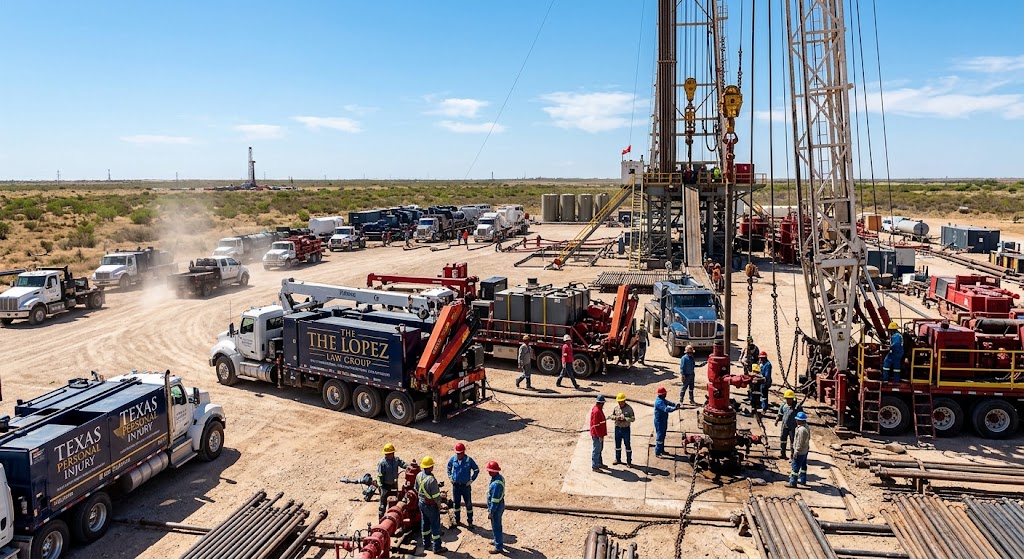
Walk any active location and count the logos. There is the operator who holds the lease. There is the drilling contractor who owns the rig. There are service crews running wireline, coil tubing, frac equipment or casing. There is a trucking company hauling water, sand or crude down a lease road. Somewhere upstream there is an equipment manufacturer who built the valve, the blowout preventer, the winch or the catwalk. Any of them can be a defendant in the right case and each brings its own insurance.
This is also where Texas law gets narrow and where a lot of oilfield injury claims die. Texas Civil Practice and Remedies Code Chapter 95 says a property owner is generally liable to a contractor employee for a premises or improvement injury only if the owner retained control over the way the work was performed and had actual knowledge of the danger. Control is a fact question and it is won or lost with documents. Job safety analysis sheets. Daily drilling reports. Written stop work authority. What the company man actually told the crew that morning. Get those before they disappear and the case looks very different. Miss them and an operator with real exposure walks away. Our article on proving negligence in oilfield accidents goes deeper into that evidence.
There is one more layer nobody mentions on the rig. The master service agreements between these companies contain indemnity provisions that decide who actually pays even after fault is assigned. Two companies can agree in advance which one absorbs a loss. That contract can quietly determine where the money comes from.
Non Subscriber, defined. A Texas employer that has chosen not to carry workers compensation insurance. A non subscriber can be sued directly by an injured employee for full damages and under Texas Labor Code Section 406.033 it cannot argue the worker was careless, assumed the risk or was hurt by a coworker mistake. Bringing a non subscriber employer claim is often the difference between a benefit check and a real recovery.
How to File an Oilfield Injury Claim in Texas Step by Step
The oilfield accident claims process in Texas rewards people who move early. Evidence on a working location does not sit still. Here is the order that protects a claim.
- Get treated and tell the doctor it happened at work. That first medical record sets the causation timeline and insurers attack claims where it is missing.
- Report the injury to your supervisor in writing and keep your own copy. Text messages count.
- Photograph the scene, the equipment and the safety board before the site is cleaned up and the tools are swapped out.
- Write down every company on that location. Operator, drilling contractor, service crews, trucking. Names on trucks and hard hats matter later.
- Verify whether your employer subscribes to workers compensation. Check it yourself through the free coverage lookup at the Texas Department of Insurance instead of asking the safety man.
- Preserve the evidence. Request the incident report. Ask in writing that the failed tool, valve or line be held. Note whether the incident was reported to OSHA.
- Say no to a recorded statement from any adjuster or third party administrator until you have talked to an oilfield injury attorney.
- Track every dollar out of pocket and every hitch you miss. Receipts and schedules turn into damages.
- Talk to a lawyer before you sign anything. Releases, safety bonus paperwork and occupational benefit plan elections have all been used to close doors on injured workers.
The Accidents That Produce the Largest Texas Settlements
Oilfield accidents occur in patterns and some patterns carry far more value than others. It is not about drama. It is about how many companies were involved and how much insurance sits behind them.
- Blowouts and well control failures. Catastrophic burns and fatalities with several corporate defendants and multiple layers of coverage.
- Explosions and flash fires. Flowback, tank batteries and gas buildup. An oilfield burn injury carries lifetime care costs and drives oilfield explosion settlement values in Texas higher than almost any other category.
- Falls from the derrick, mast or elevated platform. Spinal cord damage and traumatic brain injury.
- Struck by and caught between incidents. Tongs, pipe, catheads and winch lines. Amputations and crush injuries.
- Hydrogen sulfide exposure. Sudden fatalities that trace back to monitoring failures and training failures.
- Lease road and highway crashes. The largest single category of oilfield deaths and often the cleanest third party trucking claim.
- Pressure control and equipment failure. Product liability against an equipment manufacturer, which supports both fracking accident settlement claims in Texas and pipeline accident injury payout claims.
- Crane, rig up and rig down incidents. Multiple contractors on one job and a contested question of who controlled the work.
Refinery and downstream cases follow a similar structure. A refinery explosion injury lawyer chases the same evidence trail as a rig accident file: control, maintenance history and the contract stack.
Deadlines, Fault and Damage Limits Under Texas Law
You generally have two years from the date of the injury to file and missing that date ends a good case as surely as a bad one.
Texas applies modified comparative fault with a 51 percent bar. If a jury assigns you more than half the blame you recover nothing. At 50 percent or less your recovery is reduced by your share. Insurers know this and they spend real money building a fault argument against injured oilfield workers, which is exactly why the loss of those defenses against a non subscriber matters so much.
For families, a death case adds its own rules about who may bring the claim and what exemplary damages are available. The two year clock applies there too.
Texas Law You Should Know
- Two year filing deadline. Texas Civil Practice and Remedies Code Section 16.003 applies to personal injury and wrongful death claims. Narrow exceptions exist for a minor or for an injury that could not reasonably have been discovered. Our page on the Texas personal injury statute of limitations covers those exceptions.
- Modified comparative fault, 51 percent bar. Texas Civil Practice and Remedies Code Section 33.001.
- Non subscriber loses its defenses. Texas Labor Code Section 406.033.
- Gross negligence exception against a subscriber employer. Texas Labor Code Section 408.001(b), available to a surviving spouse or heirs in a death case. This is the path for a gross negligence oilfield accident claim in Texas.
- Property owner liability for contractor injuries. Texas Civil Practice and Remedies Code Chapter 95, requiring both retained control and actual knowledge.
- Exemplary damages cap. Texas Civil Practice and Remedies Code Section 41.008.
- Who may file a death claim. Texas Civil Practice and Remedies Code Section 71.004 gives standing to a surviving spouse, children and parents.
What the Numbers Say About Texas Oilfield Work
The people selling you an average settlement figure rarely show you government data. Here is what the record actually shows about how dangerous this work remains and why so many oilfield workers can file outside the workers compensation system.
| Statistic | Year | Source | Why It Matters |
|---|---|---|---|
| 557 fatal occupational injuries in Texas | 2024 | Texas Department of Insurance and BLS Census of Fatal Occupational Injuries, Texas report published March 2026 | The statewide baseline for workplace death claims |
| 36 Texas deaths in mining, quarrying and oil and gas extraction plus 26 more in support activities for oil and gas operations | 2024 | TDI and BLS Texas Census of Fatal Occupational Injuries | Most oilfield deaths hit contractor and service company crews, the group most likely to have a third party claim |
| Natural resources and mining fatalities rose 22 percent year over year and made up 12 percent of Texas private sector workplace deaths | 2023 to 2024 | TDI and BLS Texas Census of Fatal Occupational Injuries | Answers the argument that the industry has already fixed itself |
| 242 Texas workplace deaths or 43 percent of all of them, were transportation incidents | 2024 | TDI and BLS Texas Census of Fatal Occupational Injuries | Lease road and hauling crashes kill more Texas workers than anything else and usually produce the cleanest third party claim |
| 5,070 fatal work injuries nationwide at a rate of 3.3 per 100,000 full time equivalent workers | 2024 | U.S. Bureau of Labor Statistics, Census of Fatal Occupational Injuries Summary | The national benchmark for comparison |
| 24 percent of Texas employers were non subscribers, employing 13 percent of Texas workers | 2024 | Texas Department of Insurance Division of Workers Compensation, Biennial Report to the 89th Legislature, November 2024 | Roughly one in four Texas employers can be sued directly for a workplace accident |
The Bureau of Labor Statistics and the CDC Fatalities in Oil and Gas Extraction database publish this data year after year. Texas oil work still kills people at a rate the rest of the economy does not come close to.

Seven Mistakes That Shrink an Oilfield Injury Claim
- Assuming workers compensation is your only option. About a quarter of Texas employers carry none and if yours is a non subscriber you may be able to sue directly for pain and suffering that benefits never pay.
- Giving a recorded statement early. A sentence you said on pain medication in the first week gets read back to you in a deposition a year later to argue you caused your own accident.
- Waiting to see if it heals. The two year clock runs no matter how you feel and physical evidence on a working lease is gone in days.
- Signing the occupational benefit plan paperwork unread. Many non subscriber alternative benefit plans contain arbitration clauses and liability waivers that trade away the right to file a personal injury lawsuit.
- Missing or spacing out medical appointments. Gaps in treatment are the number one argument insurance company adjusters use to discount an injury claim.
- Posting on social media. One photo at a family barbecue becomes their proof that you are not impaired.
- Looking only at your employer. The operator, the service company, the trucking outfit or the equipment maker may carry far more coverage than the company you work for and skipping them is how money gets left on the table.
What We See in These Cases
“In our experience handling oilfield accident cases across Texas, the first question that changes a case is not how badly someone was hurt. It is whether the employer carries workers compensation at all. When a company is a non subscriber it loses the defenses it would normally lean on and the case looks nothing like what the worker was told out on the lease.”
Fernando J. Lopez, The Lopez Law Group
How Insurance Companies Value and Undervalue These Claims
An adjuster builds your number from medical specials, a disability rating, your wage records and whatever they can find in your past. Then they subtract. Prior injuries get pulled into the file. Surveillance goes up. Social media gets screenshotted. None of it is personal. It is a process built to close claims cheaply.
The pressure to settle early is the real trap. An offer that arrives before you reach maximum medical improvement is an offer made without knowing what your future medical care costs. Once you sign, the door closes. If a second surgery shows up two years later, that is on you.
The fee question stops a lot of people from calling at all. It should not. Personal injury cases at our injury law firm run on a contingency fee basis, so the fee comes out of the recovery and nothing comes out of your pocket first.
When to Call a Lawyer
Not every sore back needs an attorney. Some situations do and in those the cost of waiting is real. If any of the following describes your situation, talk to someone before the insurance company builds its file without you.
- Your injury required surgery or a hospital stay or it will keep you off the rig for more than a few hitches.
- Your employer does not carry workers compensation or somebody handed you an occupational injury benefit plan to sign.
- More than one company was working on that location the day you were hurt.
- Equipment failed. A valve, a line, a winch or a vehicle did something it was not supposed to do.
- An adjuster has already called you or floated a settlement number.
- A loved one has been injured badly or killed and the family is being asked to sign paperwork.
Attorney Lopez handles oilfield and industrial cases for injured workers throughout the state from offices in Weslaco and Houston. He works directly with clients and there are no case managers between you and your lawyer. The consultation is free, the firm takes these cases on a contingency fee basis with no win and no fee and calls are answered 24 hours a day. You pay no attorney’s fee and no case expenses unless we recover for you. Call (956) 968-7800 to talk it through. If your case is a general workplace accident outside the energy sector, a Texas work injury lawyer handles those the same way.
Frequently Asked Questions
What is the average oilfield accident settlement in Texas?
No trustworthy average exists. Published oilfield injury settlement amounts blend a sprained wrist with a fatality and they come from firms advertising their best results, not from any neutral source. Your number depends on injury severity, lost earning capacity, employer coverage status and how much third party insurance is available. Anyone quoting a figure before reading your file is guessing.
Can I sue my employer for an oilfield accident in Texas?
Yes, if your employer is a non subscriber that does not carry workers compensation insurance. Texas Labor Code Section 406.033 lets you file a personal injury lawsuit directly against that company and strips its right to argue you were careless, assumed the risk or were hurt by a coworker. If your employer is a subscriber, workers compensation is generally your only remedy against it.
What is a non subscriber employer and why does it matter?
A non subscriber is a Texas employer that has opted out of the state workers compensation system, which is legal here and nowhere else. It matters because it changes your remedy. Instead of a benefit schedule you can pursue full damages including pain and suffering. The Texas Department of Insurance reported that 24 percent of Texas employers were non subscribers in 2024.
How long do I have to file an oilfield accident lawsuit in Texas?
Two years from the date of the injury in most cases under Texas Civil Practice and Remedies Code Section 16.003 and the same two year period generally applies to wrongful death claims. Narrow exceptions exist for injuries that could not reasonably have been discovered and for claimants who were minors. Waiting past the deadline usually ends the claim regardless of how strong it was.
Can I get pain and suffering from workers compensation?
No. Texas workers compensation benefits cover medical care and a portion of lost wages and nothing for pain, mental anguish, impairment or disfigurement. Those non economic damages are only available through a lawsuit, which means through a non subscriber claim, a third party claim or a gross negligence death claim under Texas Labor Code Section 408.001(b).
Who else can be held responsible besides my employer?
The operator holding the lease, the drilling contractor, any service company on location, a trucking company hauling to or from the site and the equipment manufacturer that built a failed component. Each carries separate insurance. Third party claims run alongside a workers compensation claim rather than replacing it and they are usually where the larger recovery comes from.
How long does an oilfield accident settlement take?
Most claims we handle resolve in six to twelve months and more than 90 percent settle without a trial. Complex cases with several defendants, disputed control evidence or catastrophic injuries take longer because the full extent of future medical needs has to be established first. Settling before you reach maximum medical improvement almost always costs money.
What if I was partly at fault for the accident?
You can still recover under Texas modified comparative fault as long as you are found 50 percent responsible or less, with your award reduced by your share of blame. Cross the 51 percent line and you recover nothing under Texas Civil Practice and Remedies Code Section 33.001. Against a non subscriber employer, that argument is not available at all.
What damages can I recover in a Texas oil field injury case?
Past and future medical expenses, lost wages, loss of future earning capacity, physical pain, mental anguish, physical impairment and disfigurement. In a death case the family may also seek loss of companionship and support along with exemplary damages where gross negligence is proven. Workers compensation covers only the medical and partial wage categories.
How much does an oilfield injury lawyer cost?
Nothing up front. The Lopez Law Group handles personal injury cases on a contingency fee basis, which means the fee comes out of the recovery and you owe no attorney fee if there is none. The case evaluation is free. You do not need money in hand to find out whether you have a claim worth pursuing.
Talk to Someone Before You Sign Anything
The number on a Texas oilfield accident settlement is set by coverage structure and proof, not by how much your injury hurts. Two workers with the same broken back get different results because one had a non subscriber employer and a trucking company in the mix and the other did not. That is not fair, but it is how Texas personal injury law works and it is the reason the first phone call matters. If you were seriously injured in an oilfield or a loved one was killed, talk to a Texas oilfield accident lawyer before you give a statement or sign a release. Call (956) 968-7800 or request a free consultation online. Hablamos español.
This article is general information about Texas law and not legal advice. Reading it does not create an attorney client relationship. Every case is different and prior results do not guarantee a similar outcome.
About the Author
Fernando J. Lopez founded The Lopez Law Group and has practiced as a bilingual Texas personal injury attorney since 2007, holding State Bar of Texas card number 24060186. He has represented more than 2,500 injury clients in state and federal court as a trial attorney. He is also admitted in Kansas, Missouri, New Mexico and Washington, D.C. He works out of Weslaco and Houston and takes every client call himself. Read the full profile of Fernando J. Lopez.
Related Reading

